The History of Bioelectricity
The History of Bioelectricity
One defining feature of the nervous system is the use of electricity for communication between cells. So, before we begin an in depth study of neurons and the brain, we must first understand a bit about electricity and how it relates to neurons!The History of Bioelectricity
No playable video sources found.
Your browser does not support this video format. Try using a different browser.
0:00 / 0:00
Downloads and transcripts
Video
Download video fileTranscripts
Loading…
Discussion
Topic: Lesson 1 / The History of Bioelectricity
Introducing the Resting Potential
Introducing the Resting Potential
Neurons are able to send signals through the use of electricity, and we see that neurons themselves are electrically charged. Specifically, the lipid membrane of neurons separates solutions of charged particles, such as K+ and Na+ ions, and this separation creates a difference in potential energy across the lipid membrane. At rest, this potential difference is called the ‘resting potential.’ As you watch, ask yourself:- What are the main parts of a neuron?
- What is a ‘membrane potential’? How can you measure it?
- What are the most important ions that affect a neuron’s membrane potential?
Introducing the Resting Potential
No playable video sources found.
Your browser does not support this video format. Try using a different browser.
0:00 / 0:00
Downloads and transcripts
Video
Download video fileTranscripts
Loading…
Loading…
Loading drag and drop problem.
Discussion
Topic: Lesson 1 / Introducing the Resting Potential
Diffusion and Electrostatics
Diffusion and Electrostatics
Both inside and outside of the neuron, ions and other particles exist in an aqueous solution and are able to move around. There are many forces that can guide their behavior, two of which are important to us: the diffusive and electrostatic forces. It’s important for us to understand how these forces affect the movement of charged particles such as K+ and Na+ ions, since the movement of these ions across the membrane of a neuron can change its membrane potential. Both of these forces will be important for us when understanding how the resting potential is established. By the end of this video, you should be able to answer the following questions:- What are diffusive and electrostatic forces?
- How can these forces affect the movement of an ion across a neuron’s membrane?
Video
No playable video sources found.
Your browser does not support this video format. Try using a different browser.
0:00 / 0:00
Downloads and transcripts
Video
Download video fileTranscripts
Loading…
Loading…
Discussion
Topic: Lesson 1 / Diffusion and Electrostatics
Fleet Week!
Fleet Week!
Now that we understand what diffusive and electrostatic forces are, let’s get a better understanding of how these two forces interact. This video uses a metaphor to explain how the electrostatic force and diffusion counteract each other to establish the resting membrane potential.In this metaphor, female sailors represent anions, while male British and American sailors represent potassium and sodium ions, respectively. The sailors are all hanging out in two bars - there are approximately the same number of male and female sailors in both bars, but the male sailors are separated - mostly Brits in one bar, mostly Americans in the other.
In a quest to establish a presence in both bars while maintaining a balance between sailors of both genders, the male sailors attempt to move between two bars, some with greater ease than others. This causes a change in the relative proportions of male and female sailors in the two bars. Thinking of this in the context of neurons - and positively and negatively charged ions - this difference in the ratio produces a membrane potential. The concepts introduced in this video are addressed in more detail on the next page.
Responses to this animation have been mixed - some people find it useful, others not useful (or even offensive). If you would prefer, you can skip this video and move on to the more in-depth discussion of these ideas on the next page. The questions that correspond to this video are ungraded.
Video
No playable video sources found.
Your browser does not support this video format. Try using a different browser.
0:00 / 0:00
Downloads and transcripts
Video
Download video fileTranscripts
Loading…
Loading…
Loading…
Discussion
Topic: Lesson 1 / Fleet Week!
The Resting Potential, Firsthand
Introduction
The previous video gave you an analogy to help you begin thinking how ions travel across the membrane. Ion movement through membrane channels is guided by diffusive and electrostatic forces, and the movement of these ions can then change the current membrane potential. Here we will consider the movement of a single ion: K+. We will investigate how an equilibrium can be reached when one ion is allowed to flow across the membrane. By the end of this activity, you should understand:- How would the membrane potential change if K+ ions are allowed to flow out of the cell, or into the cell?
- How are diffusive and electrostatic forces related to each other?
- When is equilibrium reached for the flow of charged ions?
Video 1
No playable video sources found.
Your browser does not support this video format. Try using a different browser.
0:00 / 0:00
Downloads and transcripts
Video
Download video fileTranscripts
Loading…
Now let's think about what happens when we have an imbalance of ion concentrations. We'll focus on one particular ion - potassium. Let’s introduce a concentration imbalance and increase the number of potassium ions inside the cell relative to the number outside the cell, just like in an actual neuron, as shown in the figure below. We will keep the intracellular and extracellular fluids electroneutral by making sure that there's an appropriate number of matching negative ions on both sides of the membrane.
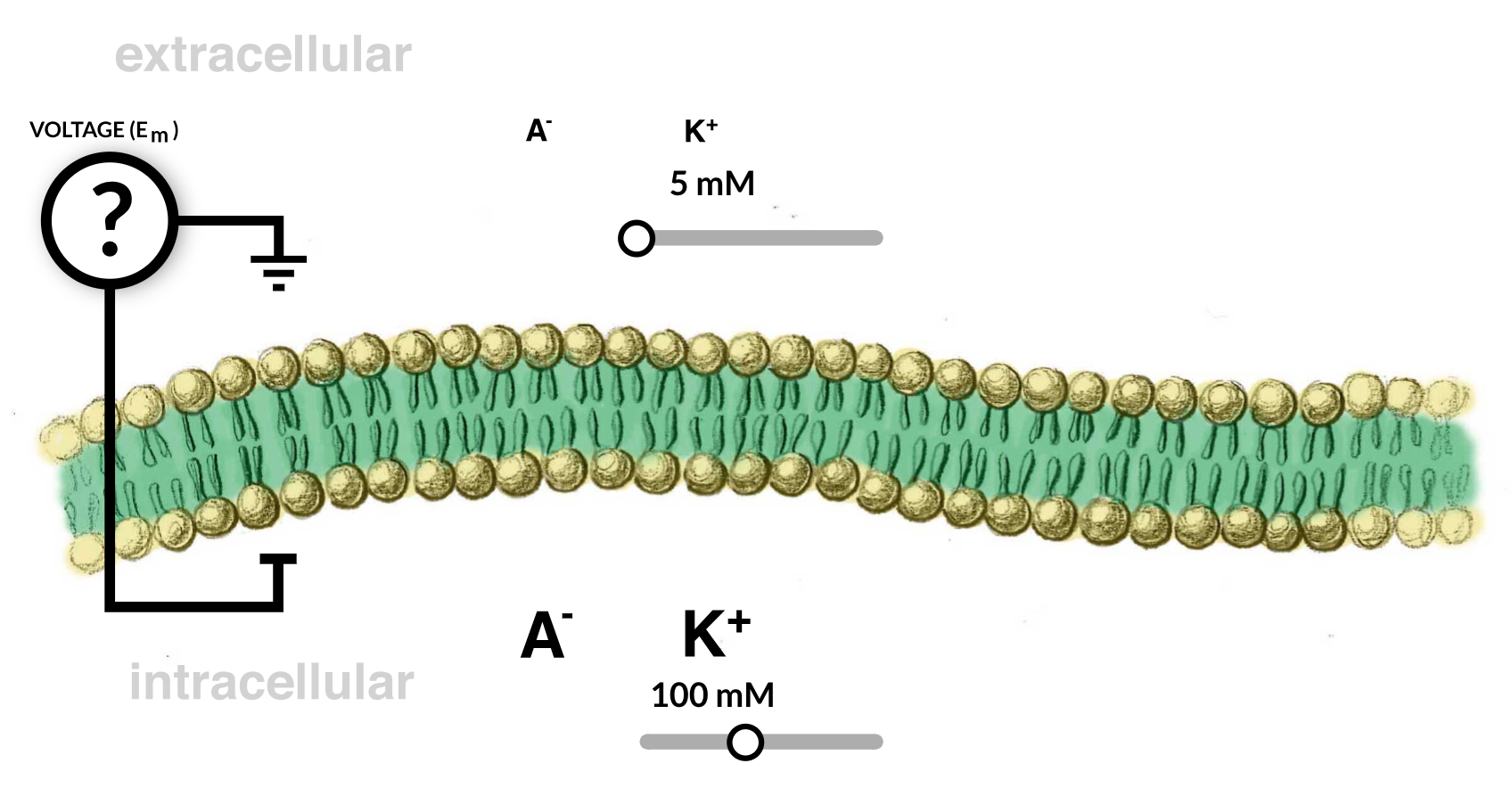
We still have an impermeable membrane - the only thing that we've changed was to alter the relative potassium concentrations.
We still have an impermeable membrane - the only thing that we've changed was to alter the relative potassium concentrations.
Loading…
What happens if we add a channel to the membrane? Specifically, let’s add a potassium channel (purple), as shown in the figure below.

Channels are passages through which ions can travel. Think about what happens to the potassium ions now that we've added a potassium channel.

Channels are passages through which ions can travel. Think about what happens to the potassium ions now that we've added a potassium channel.
Loading…
Loading…
Video 2
No playable video sources found.
Your browser does not support this video format. Try using a different browser.
0:00 / 0:00
Downloads and transcripts
Video
Download video fileTranscripts
Loading…
Video 3
No playable video sources found.
Your browser does not support this video format. Try using a different browser.
0:00 / 0:00
Downloads and transcripts
Video
Download video fileTranscripts
How many move?
Thank you.
You have used {{ submissions_count }} out of {{ max_submissions }} submissions.
Video 4
No playable video sources found.
Your browser does not support this video format. Try using a different browser.
0:00 / 0:00
Downloads and transcripts
Video
Download video fileTranscripts
Loading…
Can you see now how this concentration gradient is kind of like a little engine that drives the electrical potential? Exactly how many ions are on both sides doesn't quite matter, it's the relative concentration gradient that determines the equilibrium potential. You can check your understanding of this idea using the questions that follow.
We can formalize this relationship with something called the Nernst equation. We'll return to the Nernst equation in greater detail soon. In short, it allows us to calculate the potential across a membrane given the concentrations of a particular ion inside and outside the cell. In the previous example, when we had a membrane that was only permeable to potassium, the equilibrium membrane potential of the cell can be calculated based on the concentration of potassium inside and outside the cell. However, neurons have many ions that contribute to the resting potential so we can't determine the membrane potential of an actual cell just by looking at potassium.
We can formalize this relationship with something called the Nernst equation. We'll return to the Nernst equation in greater detail soon. In short, it allows us to calculate the potential across a membrane given the concentrations of a particular ion inside and outside the cell. In the previous example, when we had a membrane that was only permeable to potassium, the equilibrium membrane potential of the cell can be calculated based on the concentration of potassium inside and outside the cell. However, neurons have many ions that contribute to the resting potential so we can't determine the membrane potential of an actual cell just by looking at potassium.
Loading…
Loading…
Discussion
Topic: Lesson 1 / The Resting Potential, Firsthand
The Nernst Potential
Introduction
Now that you have an understanding of what forces affect ion flow and how the flow of ions can lead to changes in the membrane potential, we can utilize a formal equation. This equation is the Nernst Potential, which calculates the membrane potential at which the diffusion and electrostatic forces for an ion balance out, given particular concentrations inside and outside of the cell. This equation is very powerful in helping us to summarize the behavior of an ion given certain conditions. By the end of this lesson, you should be able to answer the following questions:- How do temperature and valence affect the Nernst Potential?
- Do the absolute or the relative concentrations of ions matter in determining the Nernst Potential? How do changes to the intracellular and extracellular concentrations of K+ affect its Nernst Potential?
- What is "driving force," and how do we calculate it?
Video 1
No playable video sources found.
Your browser does not support this video format. Try using a different browser.
0:00 / 0:00
Downloads and transcripts
Video
Download video fileTranscripts
Loading…
Video 2
No playable video sources found.
Your browser does not support this video format. Try using a different browser.
0:00 / 0:00
Downloads and transcripts
Video
Download video fileTranscripts
Loading…
In real life the actual chloride concentrations inside and outside of a neuron are a little different from that of sodium. Chloride actually has a Nernst potential very close to that of the resting potential (about -70 mV) - file this fact away in your mind for later.
Let’s finally think about how the Nernst potential depends on the concentrations of an ion inside and outside of a cell. Let’s use some actual values for calculating the Nernst potential in our interactive simulation below for the potassium concentrations. The interactive shows the concentrations of K+ inside and outside the cell, and the voltmeter indicates the current Nernst potential for K+. Let’s now do an experiment: in the interactive, investigate how changing the concentrations of an ion, here K+, affect its Nernst potential. Specifically, try to find at least two ways to create a Nernst potential of -50 mV for different sets of concentrations of K+ inside and outside of the cell. When you are finished, feel free to explore further or move on.


Let’s finally think about how the Nernst potential depends on the concentrations of an ion inside and outside of a cell. Let’s use some actual values for calculating the Nernst potential in our interactive simulation below for the potassium concentrations. The interactive shows the concentrations of K+ inside and outside the cell, and the voltmeter indicates the current Nernst potential for K+. Let’s now do an experiment: in the interactive, investigate how changing the concentrations of an ion, here K+, affect its Nernst potential. Specifically, try to find at least two ways to create a Nernst potential of -50 mV for different sets of concentrations of K+ inside and outside of the cell. When you are finished, feel free to explore further or move on.
Interactive: the Nernst Equation


Extracellular
Intracellular

-80
mV
mV
Video 3
No playable video sources found.
Your browser does not support this video format. Try using a different browser.
0:00 / 0:00
Downloads and transcripts
Video
Download video fileTranscripts
Loading…
Loading…
So now we see why the selectivity of ion channels is so vitally important to maintaining a resting potential in the cell. If multiple different positive ions were allowed to move across the membrane at the same time in equal numbers, the resting potential would quickly unravel. But how does that selectivity actually happen? What nature has created to allow this is actually a marvel of molecular engineering. Since this ion selectivity is so important, it’s worth a short detour to talk about how on Earth nature achieves a channel that can let K+ ions pass through but which blocks out Na+ ions.
Check your understanding of these ideas by answering the questions that follow.
Check your understanding of these ideas by answering the questions that follow.
Loading…
Loading…
Loading…
Loading…
Loading…
Loading…
Loading…
Discussion
Topic: Lesson 1 / The Nernst Potential
The GHK Equation
Introduction
So far we have mainly considered the movement of just one ion. In a resting neuron, there are many different ions present inside and outside of the cell that can travel through the membrane. Specifically, each ion is trying to flow such that it reaches its own equilibrium. There is a steady state when the ion flows are counterbalanced, and the resting potential of the cell is an example of a steady state. We can calculate this resting potential for a cell using the GHK equation. By the end of this video, answer the following questions:- What is permeability, and how does it factor into the GHK equation?
- How are the GHK equation and the equation for the Nernst potential related?
- For a regular neuron, which ions are most and least permeable?
Video 1
No playable video sources found.
Your browser does not support this video format. Try using a different browser.
0:00 / 0:00
Downloads and transcripts
Video
Download video fileTranscripts
Interactive: Changing Concentrations
As you saw in the video above, the GHK equation shows that the two most important factors in determining the resting potential of a neuron are: (1) the concentrations of particular ions inside and outside of the membrane and (2) the permeabilities of these ions. We will investigate how these different properties can affect the membrane potential.Below is a diagram of a cell membrane with Na+ and K+ channels in it. The voltmeter provides a readout of the membrane potential. You can use the sliders to change the concentrations of K+ and Na+ ions both inside and outside the cell. If you use the sliders to change the concentrations, the voltmeter will read out the new membrane potential. Note here that the permeabilities of Na+ and K+ ions have been fixed, specifically with a high K+ permeability and a low Na+ permeability just like in an actual neuron.
Right now, the ion concentrations are set to values similar to that of a regular resting neuron. Using the sliders below, try to make the membrane potential equal to -55 mV by changing the concentrations of Na+ and K+. We have "locked" the concentration of chloride ions at 10 mM inside the cell and 140 mM outside the cell.

Extracellular
Intracellular
-80
mV
mV
As you saw, there are many different ways that you could get to a membrane potential of -55 mV. You could either make the potassium inside the cell decrease, or increase the potassium outside the cell. With sodium, you could increase the extracellular concentration to work against the otherwise dominant influence of potassium.
We'll explore this phenomenon in more detail later, but in the meantime, did you see how far you had to move the potassium or sodium concentrations in order to achieve your goal? If the neuron wanted to change its membrane potential by moving around ions alone, it would have to expend a ton of energy pumping ions back and forth across the membrane and would probably be very slow.
You may also be wondering why we picked -55mV as the target membrane potential. It turns out that this is an important value of the membrane potential. It's around what neuroscientists call the threshold voltage. Roughly speaking, when the membrane potential reaches a value close to this threshold, the neuron fires something called an action potential to communicate with other neurons. If that threshold isn't reached, the neuron stays inactive.
We'll talk about action potentials in a future lesson, but suffice it to say, reaching threshold is very important for activity in the nervous system. So if changing ion concentrations is slow and metabolically expensive, how will we reach this threshold?
We'll explore this phenomenon in more detail later, but in the meantime, did you see how far you had to move the potassium or sodium concentrations in order to achieve your goal? If the neuron wanted to change its membrane potential by moving around ions alone, it would have to expend a ton of energy pumping ions back and forth across the membrane and would probably be very slow.
You may also be wondering why we picked -55mV as the target membrane potential. It turns out that this is an important value of the membrane potential. It's around what neuroscientists call the threshold voltage. Roughly speaking, when the membrane potential reaches a value close to this threshold, the neuron fires something called an action potential to communicate with other neurons. If that threshold isn't reached, the neuron stays inactive.
We'll talk about action potentials in a future lesson, but suffice it to say, reaching threshold is very important for activity in the nervous system. So if changing ion concentrations is slow and metabolically expensive, how will we reach this threshold?
Interactive: Changing Parameters in the GHK Equation
Let’s now investigate how changing the permeability to particular ions can affect the resting potential. Below is again a diagram of a cell membrane with Na+ and K+ channels in it. The voltmeter provides a readout of the membrane potential. You can use the sliders to change the concentration of K+ and Na+ ions both inside and outside the cell, and to modify the permeability of the membrane to potassium and sodium. If you use the sliders to change the concentration and permeability values, the voltmeter will read out the new membrane potential.Now, let’s try to reach a membrane potential of -55 mV, but only by adjusting the permeabilities of the ions. We've left the ion concentration sliders in case you need to adjust the concentrations, too, but see if you can reach -55 mV without using them! (The chloride concentrations remain the same as they were earlier - 10 mM inside the cell and 140 mM outside the cell.)
Extracellular
Intracellular
-80
mV
mV
Hopefully you saw how sensitive the neuron is to the Na+ permeability. This makes sense because of Na+'s large driving force. Recall that driving force is a measure of the difference between the current membrane potential and the Nernst potential for an ion, which in Na+'s case is a very large difference. So, why not open up the floodgates?
The Na+ ions are eager to rush across the membrane to bring the -70 mV closer to the Nernst potential of Na+, which is around 60 mV. As we'll see in a future lesson, this is actually an important trick that neurons use to send signals. Flicking a molecular switch to increase the permeability of the membrane to Na+ is much easier than drastically changing the ions concentrations! It also takes advantage of the diffusion and electrostatic gradients that's already built up as we'll learn in the next few sections. This is the key to how neurons communicate with each other.
The Na+ ions are eager to rush across the membrane to bring the -70 mV closer to the Nernst potential of Na+, which is around 60 mV. As we'll see in a future lesson, this is actually an important trick that neurons use to send signals. Flicking a molecular switch to increase the permeability of the membrane to Na+ is much easier than drastically changing the ions concentrations! It also takes advantage of the diffusion and electrostatic gradients that's already built up as we'll learn in the next few sections. This is the key to how neurons communicate with each other.
Loading…
Loading…
Loading…
Loading…
Loading…
Loading…
Loading…
Loading…
Discussion
Topic: Lesson 1 / The GHK Equation
Ion Filters
Ion Filters
So far we’ve been talking about how different ions, such as K+ and Na+, move across the membrane. They do so by passing through ion channels, many of which are selective for particular ions. But how can an ion channel differentiate between two extremely small ions? The video will address these questions by addressing two key questions:- What is a ‘solvation shell’?
- How are Na+ ions excluded from K+ selective ion channels?
Video
No playable video sources found.
Your browser does not support this video format. Try using a different browser.
0:00 / 0:00
Downloads and transcripts
Video
Download video fileTranscripts
Loading…
Loading…
Discussion
Topic: Lesson 1 / Ion Filters
The Sodium/Potassium Pump
So far we’ve been discussing the importance of ion concentration gradients across the membrane of a neuron. These gradients are important because they cause ions to flow in particular directions across the membrane and establish an electrical potential. As is hopefully evident, the maintenance of these concentration gradients is very important for neuronal function. Here we will discuss a particular pump, called the Na+/K+ pump, that is very important to neurons. By the end of this video, you should be able to answer:
- What is the role of the Na+/K+ pump in neurons?
- What would happen to a neuron if the Na+/K+ pump was damaged?
No playable video sources found.
Your browser does not support this video format. Try using a different browser.
0:00 / 0:00
Downloads and transcripts
Video
Download video fileTranscripts
Loading…
Loading…
Loading…
Discussion
Topic: Lesson 1 / The Sodium Potassium Pump

Comments
Post a Comment